
Who this guide is for
- Learners with strong vocabulary whose writing still contains unusual word combinations
- Professionals and students developing business, academic, or domain-specific English
- People who know nouns but hesitate over the right verb, preposition, or adjective
- Anyone who needs a workflow from authentic input to usable output
What is a collocation—and how is it different from an idiom or term?
A collocation is a combination language users prefer, such as pose a risk, draw a conclusion, or highly likely. The meaning may be transparent, but the choice is constrained: English normally uses heavy rain, not strong rain.
An idiom such as spill the beans is less transparent. A term such as gradient descent is defined primarily by a domain. Categories overlap, but learning priorities differ: idioms require figurative and pragmatic knowledge, terms require precise concepts, and collocations require knowledge of co-occurrence, form, and substitution limits.
| Type | Example | Core question |
|---|---|---|
| Collocation | raise a concern | How do speakers normally combine these familiar words? |
| Idiom | bend over backwards | How far is the whole meaning from the literal words? |
| Term | confidence interval | What is the precise domain definition? |
| Frame / bundle | It is worth noting that… | How does this organize argument or interaction? |
Why definitions create “I know it but cannot use it”
Knowing that concern refers to worry does not tell you which verb to choose. Common partners include raise, address, express, share, and each performs a different action. You raise a concern to introduce it and address a concern to respond to it.
Collocations also reduce production cost. If every sentence must be assembled one word at a time from grammar and definitions, fluency suffers. Familiar chunks can be accessed as larger units. Research on formulaic language treats multiword sequences as important to L2 processing and proficient use.
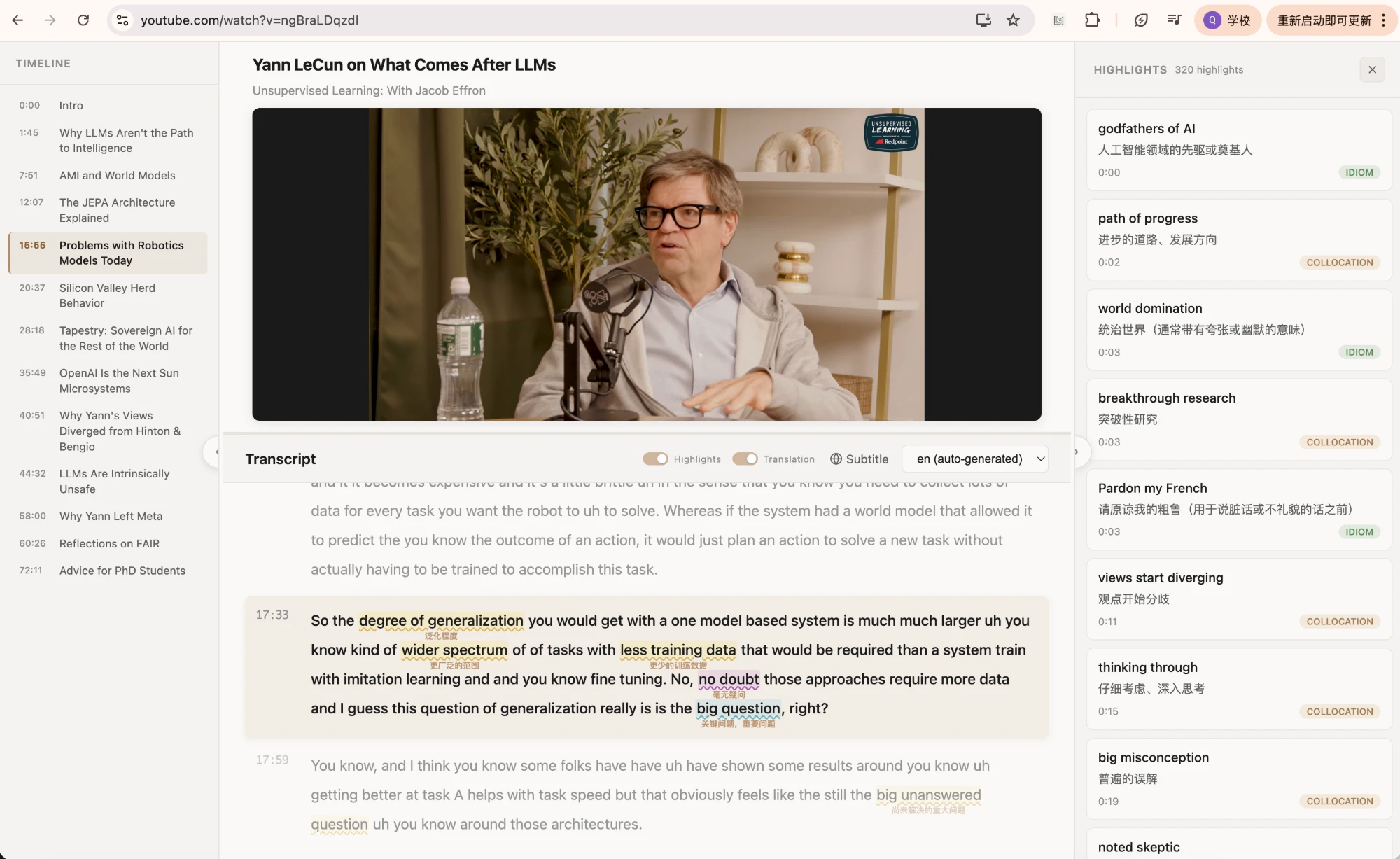
Collect from real content instead of downloading a giant list
A generic list is not necessarily wrong; it lacks personal priority and context. A product manager may repeatedly need validate an assumption, while a researcher needs yield a result. Pages, captions, email, and papers supply topic, relationship, and register together.
LeMingle can surface collocations and other expressions in material you already read or watch. Treat highlights as candidates. Save according to comprehension leverage, likelihood of recurrence, and a real output need.
- Understand the sentence firstIdentify what the writer or speaker is doing before isolating two highlighted words.
- Preserve the collocation boundaryKeep articles, prepositions, and grammar that matter: take responsibility for, not only responsibility.
- Record register and sceneNote formal, conversational, critical, or technical use and the relationship between speakers.
- Create a personal variationKeep the frame and replace a component from your own work or life.
Case study: the verb changes what “concern” does
Raise a concern introduces an issue. Address a concern responds to one. Dismiss a concern evaluates it as unworthy of attention. Allay concerns reduces worry through information or action. A card reading concern = worry cannot support those choices.
Now include the frame: Several reviewers raised concerns about data quality. Transfer it to: I want to raise a concern about the rollout timeline. The plural option and about are part of usable knowledge.
Use a richer collocation card
A two-sided English–translation card can produce familiarity without testing form. Keep at least four fields: complete pattern, original sentence and scene, direct meaning and register, and a personal variation.
Add restrictions when they matter. Commit in commit a crime often selects wrongdoing; strong evidence is conventional where powerful evidence is less typical in general prose.
| Field | Example |
|---|---|
| Complete pattern | raise a concern about sth |
| Original scene | A review meeting about data quality |
| Meaning / register | Introduce a worry formally and calmly |
| Personal variation | raise a concern about the launch date |
| Constraint | concern(s); commonly about / over |
Verify: one occurrence does not prove a stable pattern
Real pages can contain idiosyncratic style, learner English, or errors. Before producing a new combination, check a reputable learner dictionary, domain corpus, or several independent examples. Look for recurrence in the same sense, typical grammar, and matching register.
Verification is not about inventing one rigid rule. Collocations vary in strength. Make a decision is strongly conventional; reach a decision is also natural but foregrounds arriving at an outcome. Build probability judgment, not another list of prohibitions.
Move from recognition to use with three kinds of retrieval
Form retrieval gives a context and asks you to complete the phrase. Meaning retrieval presents the phrase and asks for a direct explanation. Use retrieval starts with your situation and asks you to produce the phrase. These are different kinds of knowledge.
Research suggests that meaning-focused exposure alone may not reliably build productive collocation knowledge; drawing attention to form and encountering items repeatedly can help. Mechanical repetition alone is also insufficient for flexible use. A stronger loop is authentic input → explicit form → spaced retrieval → new-context use.
- Today: substitute one componentKeep the collocation and change the topic to your own.
- Tomorrow: hide the core wordComplete the phrase from context and tone.
- This week: meet it in a new contextCompare partners, register, and meaning.
- This week: use it once for realPut it in an email, meeting note, study summary, or spoken recap.
Common mistake: “advanced” does not mean useful
Frequent, precise, context-appropriate combinations beat rare prestige phrases. Make progress looks ordinary but is more useful than forcing an ornate alternative. Naturalness comes from expected choices, not maximal complexity.
Do not learn every collocation of one noun at once. Build small networks around real tasks: introducing issues, resolving them, reducing risk, or supporting a conclusion. A themed micro-network enters output more easily than dictionary-scale enumeration.
Frequently asked questions
What is the difference between a collocation, phrase, and idiom?
A collocation is a preferred combination whose meaning is often transparent. An idiom may be figurative and opaque. Phrase is a broad structural label. In practice the categories can overlap, so focus on form, meaning, register, and use.
How many collocations should I learn per day?
The right number depends on retrieval and use. For a busy learner, three to five items from real content, each with a personal variation, is more sustainable than scanning dozens.
How can I check whether a collocation is natural?
Use a reputable learner dictionary and several independent examples. Compare grammar, register, typical partners, and meaning rather than relying on a raw search count.
Sources and verification
- Formulaic Sequences: Acquisition, Processing and UseFoundational research on multiword sequences and L2 processing.
- Effects of meaning- and form-focused instruction on verb–noun collocationsA study comparing meaning work with explicit attention to collocational form.
- Learning L2 formulaic sequences from meaning-focused activitiesA synthesis of salience, repetition, and multimodal input research.
- Incidental learning of collocations through different multimodal inputA 2024 study of reading, reading-while-listening, and captioned viewing.