
Who this guide is for
- People who read English industry news, documentation, papers, or email every day
- Learners who understand the gist but miss professional collocations and natural phrasing
- Anyone who has abandoned vocabulary lists because capture and review became another job
- Professionals who want learning embedded in existing work rather than a separate course
The advantage of real pages is more than “authentic content”
A textbook controls vocabulary and sequence. A real page shows language performing a job: documentation removing ambiguity, an abstract limiting a claim, journalism signalling uncertainty, or an email disagreeing without damaging a relationship. You see expression, register, purpose, and domain knowledge together.
The page, however, has no teaching sequence. It contains navigation, names, rare terminology, and many items that do not deserve long-term attention. If every unfamiliar item becomes a lesson, the argument disappears. The first principle is therefore to protect the task that brought you to the page.
Use two modes: information first or language first
Information mode fits urgent, unfamiliar, or high-stakes material. Use the translation and terminology support necessary to understand it accurately; there is no obligation to turn the same page into a language lesson. Language mode fits familiar, mostly comprehensible material with reusable language. Here the goal is to notice phrasing without losing the argument.
These are not competing identities. A professional may need information mode for a contract and language mode for a familiar product essay. Skilled readers switch by task.
| Decision | Information mode | Language mode |
|---|---|---|
| Primary goal | Accurate, fast access | Comprehension plus reusable language |
| Best material | Contracts, urgent or unfamiliar domains | Industry writing, familiar research, news |
| Lookup strategy | Paragraph or full-page support is acceptable | Finish the paragraph, then inspect selectively |
| Items saved | Possibly none | Roughly two to five per page |
| Done means | You can complete the real task | You can summarize and explain selected phrases |
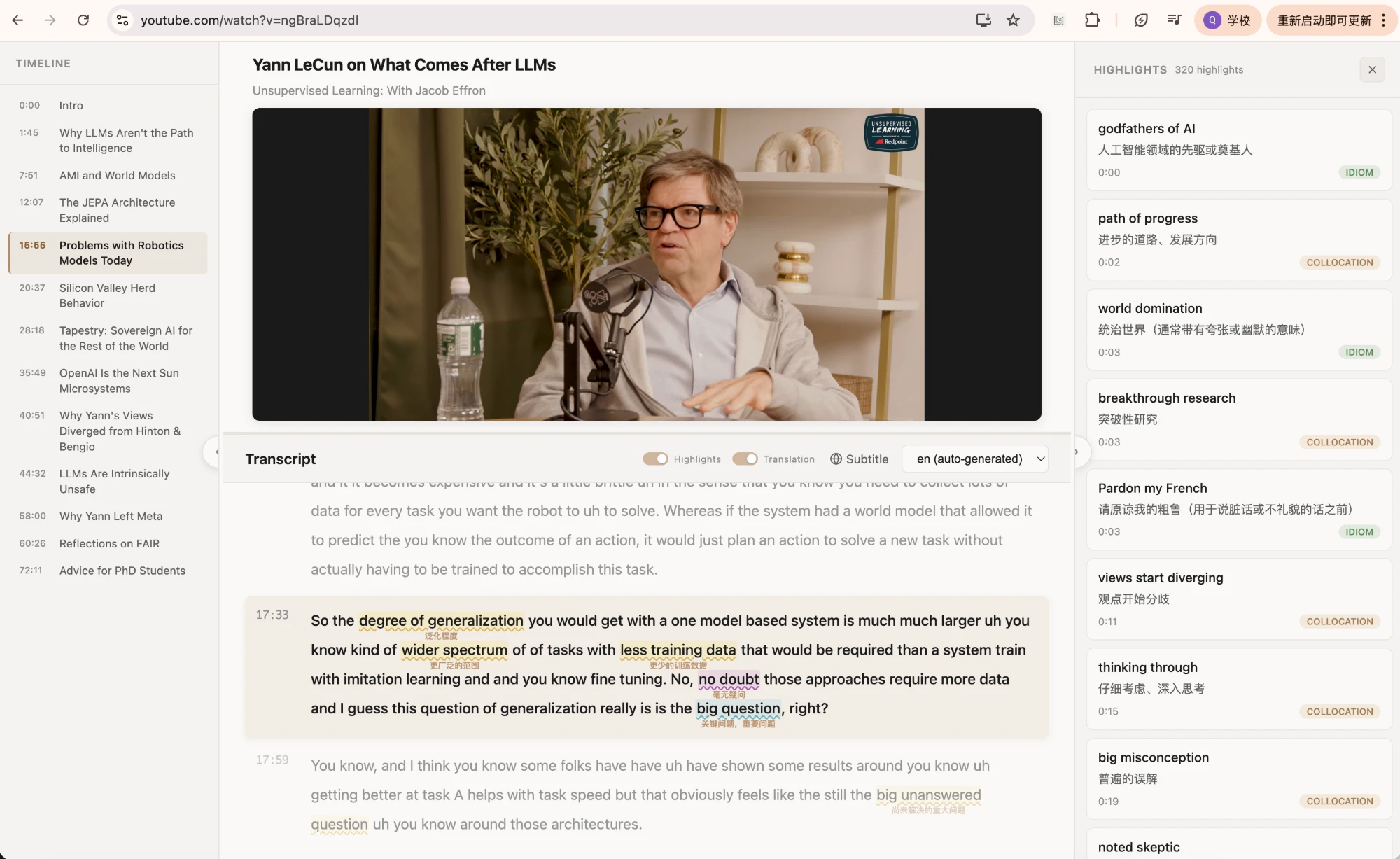
The two-pass paragraph: preserve the argument before studying language
Hovering every highlight forces constant switching between meaning and form. A paragraph-level routine is steadier: finish the idea first, then return to the language.
- Read to the paragraph boundaryDo not stop for one item. State what the writer is doing: framing a problem, presenting evidence, conceding, challenging, or concluding.
- Inspect only leverage pointsOpen phrases that caused a wrong interpretation, carry tone, or are reusable in your domain. Highlights narrow the search space; they are not homework.
- Transform one original sentenceReplace a component or paraphrase the line in your own situation. This tests use rather than recognition of a translation.
- Return to the reading taskStop capturing when you reach your page limit. Decide what survives only after the article is complete.
Example: what is actually worth learning from a product update?
Imagine the page says: “The rollout hit a snag, but the team ironed out the issue before it snowballed.” Saving only rollout gives you a product term. The sentence also contains an event chain: hit a snag introduces an unexpected obstacle, iron out an issue describes resolving it through work, and snowball describes rapid escalation.
You still do not need all three. A project manager might keep iron out the issue and produce: We need another day to iron out the migration issues. That creates a frame ready for a real email.
Filter by meaning leverage, relevance, and recurrence
Browsing systems fail when collections grow faster than memory. Test each candidate: would missing it distort this page? Does it belong to a recurring part of your life? Is it likely to appear across sources? Save when at least two answers are yes.
Also separate terminology from transferable expression. Zero-day vulnerability may be essential information in one domain without becoming active vocabulary for everyone. Raise a concern travels across domains. Both matter, but they belong to different personal systems.
| Candidate | Comprehension value | Reuse value | Action |
|---|---|---|---|
| Meaning-changing idiom | High | Medium to high | Investigate first |
| Frequent domain collocation | High | High | Strong save |
| One-off proper noun | Task-dependent | Low | Resolve and move on |
| Ordinary word inferable from context | Low | Personal | Do not interrupt |
| Argument-organizing phrase | Medium | High | Useful for writing and speaking |
Why a later encounter adds more than another look at the same card
A phrase seen with a new writer, syntax, and topic supplies information the first example could not: typical partners, register, evaluation, and restrictions. Research on formulaic language treats knowledge as more than a rough meaning; form, association, and conditions of use matter too.
LeMingle re-highlights saved expressions on later pages and videos. The color does not create memory. It creates a retrieval opportunity: recall the meaning and previous scene before opening the explanation, then compare what changed in the new sentence.
A one-week workflow that does not become another course
Choose one English source you already visit weekly. The first week builds selection discipline; the second reveals genuine recurrence; only then add output practice.
| Stage | Action | Constraint |
|---|---|---|
| Mon–Wed | Read one necessary page per day | Maximum three saves per page |
| Thu | Notice which phrases returned | Recall before revealing help |
| Fri | Use three items in a work summary | Consult the original; do not copy it |
| Weekend | Delete low-value captures | Keep language tied to real goals |
The limits of learning while browsing
This approach is strongest for learners already exposed to substantial English who lack a noticing and retention mechanism. It is a poor substitute for foundational instruction when every sentence requires translation, and it cannot replace systematic grammar, pronunciation feedback, or real interaction.
The goal is not to turn every website into a classroom. It is to become sensitive to patterns you used to read past, with an intervention light enough to sustain and selective enough to produce language you might genuinely use.
Frequently asked questions
Does learning English while browsing reduce reading efficiency?
It can if you open every highlight. Use paragraph-level two-pass reading and a page limit. Complete the meaning first; inspect only a few phrases afterward. Switch fully to information mode for urgent or high-stakes material.
Should I save individual words or whole phrases?
Save a complete expression and its sentence when natural use depends on collocation, tone, or structure. Clear proper nouns and isolated technical terms can be handled separately.
Is re-highlighting enough to remember a phrase?
No. It creates an opportunity. Recall the meaning, tone, and earlier context before opening help, and occasionally use the phrase in your own sentence.
Sources and verification
- Formulaic Sequences: Acquisition, Processing and UseResearch on the form, processing, and acquisition of formulaic language.
- Learning L2 formulaic sequences from meaning-focused activitiesA review of salience, repetition, and multimodal input in phrase learning.
- Repeated retrieval and second-language vocabulary learningResearch on retrieval frequency and longer-term L2 vocabulary learning.