Who this guide is for
- B1–C1 learners who follow the main idea but miss idioms, reduced speech, or implied meaning
- Professionals and students who already watch interviews, talks, lectures, or industry videos in English
- Learners with large saved-word lists but little confidence using natural phrases
- People who want a repeatable routine rather than a promise that passive watching will be enough
Why YouTube is excellent input—but not automatically a lesson
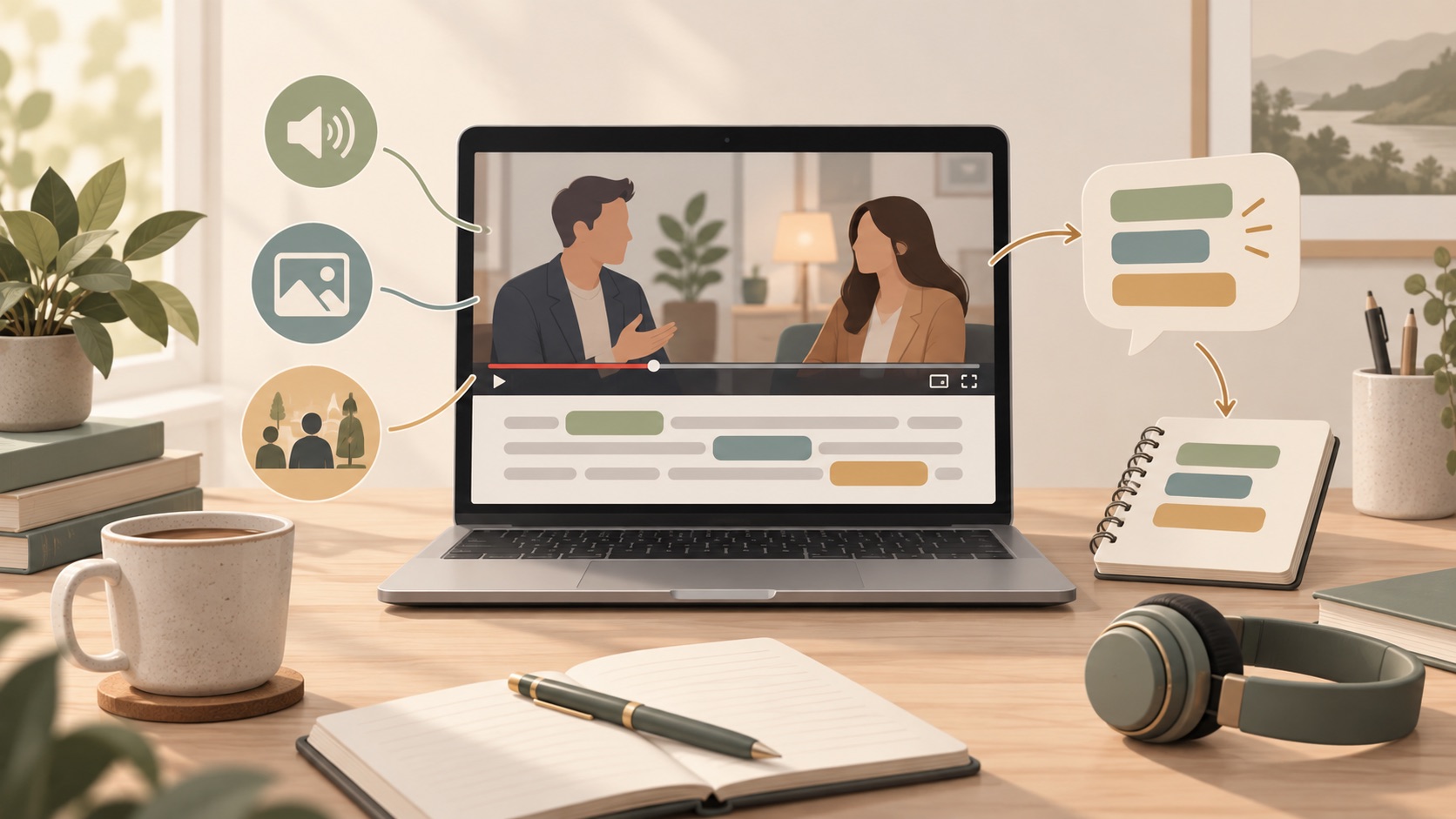
Video combines speech, facial expression, setting, topic knowledge, and written captions. Those cues can make the speech stream easier to segment and interpret. Meta-analyses of captioned L2 video report benefits for listening comprehension and vocabulary learning, but that evidence does not mean any captioned viewing session produces durable learning. Attention and follow-up still matter.
Two failure modes are common. In entertainment mode, you understand the story but never attend to how an idea was expressed. In lookup mode, you pause for every unknown word, fragment the argument, and finish with neither a coherent understanding nor a usable phrase. A good routine protects meaning first and selects language second.
Choose the right 5–12 minutes, not the “best English channel”
Material is useful when the message is mostly comprehensible before you start studying it. On a first uninterrupted viewing, you should identify the topic, main claim, and most causal links while still noticing a few genuine gaps. If every line contains several unknown items, move to a familiar topic. If nothing challenges comprehension, use the clip for pronunciation and expression work rather than basic meaning.
For professional learners, a familiar interview, product discussion, research talk, or technical explainer is often better than a generic lesson. Background knowledge frees attention for language form.
| Dimension | Good for focused study | Poor fit for now |
|---|---|---|
| Topic | Relevant or already familiar | Conceptually new and densely technical |
| First-pass comprehension | You can retell the main line | You only recognize scattered words |
| Captions | Reliable English captions | Automatic captions with frequent errors |
| Audio | One or two clear speakers | Overlapping speech or music masking voices |
| Scope | A 5–12 minute segment | A full long-form episode on day one |
The three-pass method: meaning, language, retrieval
The point of three passes is not repetition for its own sake. Each pass has one cognitive job, so you are not translating, taking notes, imitating pronunciation, and following the argument at the same time.
- Pass 1: build the meaning mapKeep first-language translation off and avoid pausing. Identify who is speaking, what they claim, and exactly where comprehension breaks down.
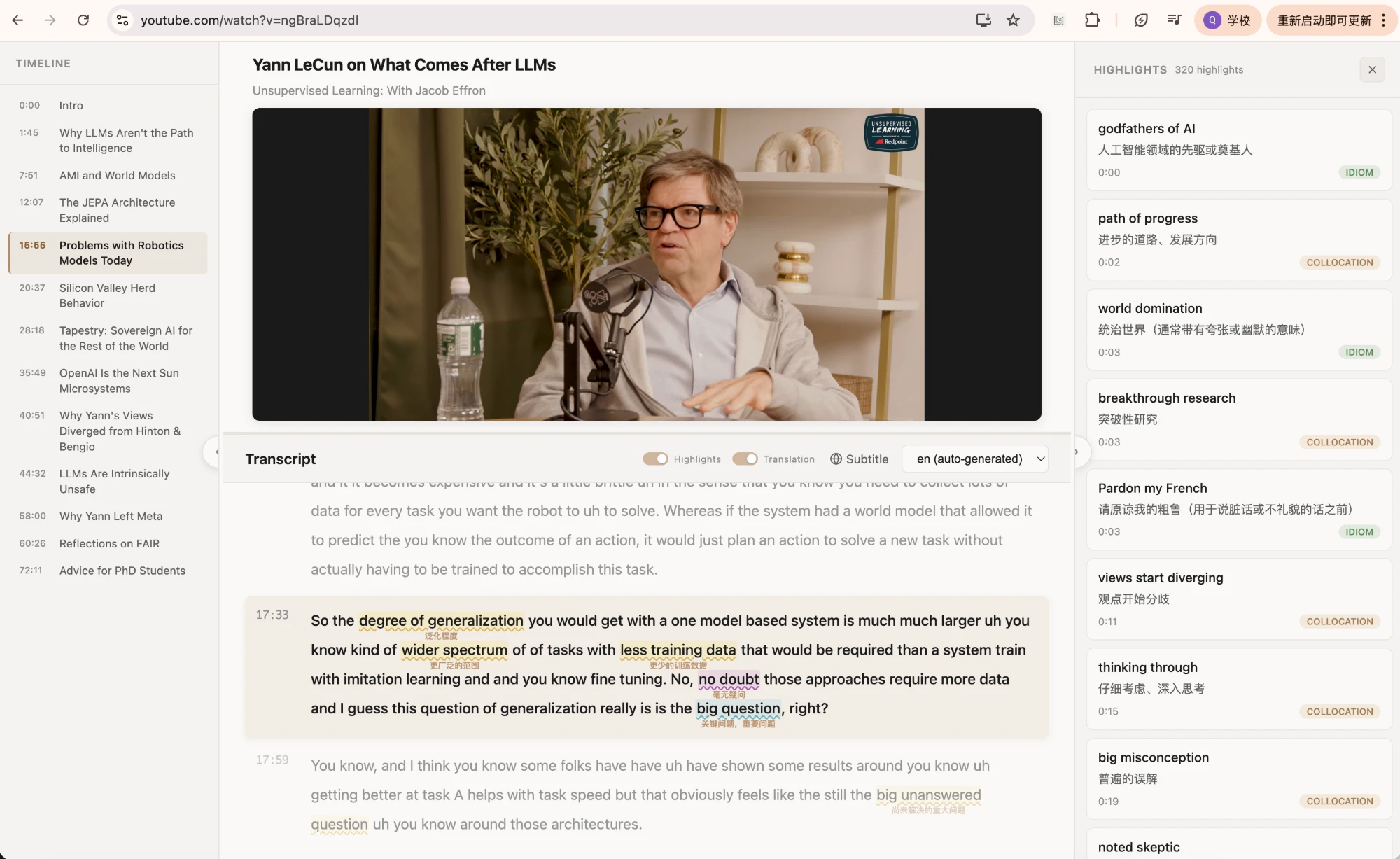
- Pass 2: resolve a few high-value gapsUse English captions or Reader. Stop only for a phrase that changes the sentence, recurs, or is highly relevant to your work and conversations.
- Pass 3: retrieve before receiving helpReplay line by line, paraphrase the meaning aloud, and shadow one or two sentences. The next day, try to recall the phrase and context before reopening the explanation.
A realistic problem: familiar words can still produce the wrong meaning
Consider an interview line: “I wouldn’t read too much into the first week. We’re still feeling out the market.” The individual words are common. Yet read too much into means drawing an excessive conclusion from limited evidence, while feel out the market means cautiously testing reactions. The speaker is downplaying early data and describing an exploratory phase—not discussing reading or touch.
The useful learning unit is phrase + communicative function + evidence from the scene. Read too much into X is a warning against overinterpretation. Feel out X frames an action as tentative exploration. Store that package and you can recognize it in meetings, writing, and later videos.
Use captions in a ladder: listen, align, reveal, remove
English captions align the sound stream with written form. A first-language explanation removes a specific meaning barrier. Both are scaffolds. A practical order is: listen → check the English caption → reveal contextual meaning only if needed → replay after removing the explanation.
Permanent bilingual captions can pull attention toward the easier language and away from English chunking, stress, and reduction. Refusing all captions is not inherently better. Switch support according to the problem you are solving.
| Problem | First tool | Follow-up action |
|---|---|---|
| You cannot hear word boundaries | English captions | Replay immediately after checking |
| You know the words but not the line | Contextual phrase explanation | Paraphrase the speaker’s intent |
| The topic itself is unfamiliar | Brief first-language support | Build background knowledge first |
| You understand but cannot produce it | Single-line loop | Shadow by thought group, then substitute details |
Save only three to six expressions: use a value filter
A highlighted phrase is not an assignment. Keep an expression when it changes the sentence meaning, is likely to return in your domain, or can be reused as a frame with one component replaced. A phrase such as read too much into often deserves attention before a rare concrete noun that a dictionary can resolve in seconds.
LeMingle reduces discovery cost by identifying idioms, collocations, and other expressions in captions, then re-highlighting saved items in later pages or videos. It cannot choose your life priorities or turn one click into long-term memory. Recognition in a new context and effortful retrieval still do the learning work.
- Meaning leverage: would missing it distort the whole sentence?
- Personal relevance: might it appear in your work, study, or conversations this month?
- Transferability: can you reuse the structure by replacing one element?
A realistic 25-minute session
These times are constraints, not a universal prescription. They stop one difficult sentence from consuming the entire session and make the routine easier to repeat.
| Time | Action | Evidence of completion |
|---|---|---|
| 0–6 min | Watch without translation | Retell the main line and mark gaps |
| 6–15 min | Investigate 3–6 expressions | Explain each in plain English |
| 15–21 min | Shadow two lines by thought group | Match grouping and stress, not identity |
| 21–25 min | Replay and summarize unaided | Use at least two target phrases |
| Next day | Five-minute revisit | Recall before reopening support |
Measure transfer, not watch time
A useful weekly check is whether you recognize a phrase in a new sentence, explain its tone and constraints, and use it naturally in an email, discussion, or spoken summary. Saved-item count is a capture metric, not a learning outcome.
If you understand but forget, save fewer items and add next-day retrieval. If captions-off listening collapses, use short dictation and thought-group shadowing. If your phrase is correct but socially awkward, store register, relationship, and scene—not only a translation.
Frequently asked questions
Should I use bilingual subtitles to learn English on YouTube?
Use first-language support briefly when a key meaning remains blocked. Listen first, align sound with English captions second, reveal a translation only when necessary, and replay after removing it.
How many words or phrases should I save from one video?
Start with three to six complete expressions. Prefer phrases that change the sentence meaning, matter to your life, or can be reused as a flexible frame.
What if YouTube auto-captions are inaccurate?
If errors affect sentence boundaries or key words, choose a video with human captions or clearer audio. An unreliable transcript is a poor reference for close listening and shadowing.
Sources and verification
- Captioned video for L2 listening and vocabulary learning: a meta-analysisA meta-analysis of L2 captions, listening comprehension, and vocabulary learning.
- Incidental Vocabulary Acquisition Through Captioned Viewing: A Meta-AnalysisA 2025 synthesis of incidental vocabulary learning from captioned viewing.
- Incidental learning of collocations through different multimodal inputA comparison of reading, reading-while-listening, and captioned viewing.