Who this guide is for
- Learners who understand with captions but cannot segment the same audio without them
- Speakers whose individual sounds are clear but whose sentence rhythm is flat or word-by-word
- People who want to use interviews, talks, and lessons as speaking input
- Learners who have tried shadowing but keep falling behind and do not know what to fix
Separate reading aloud, retelling, and shadowing
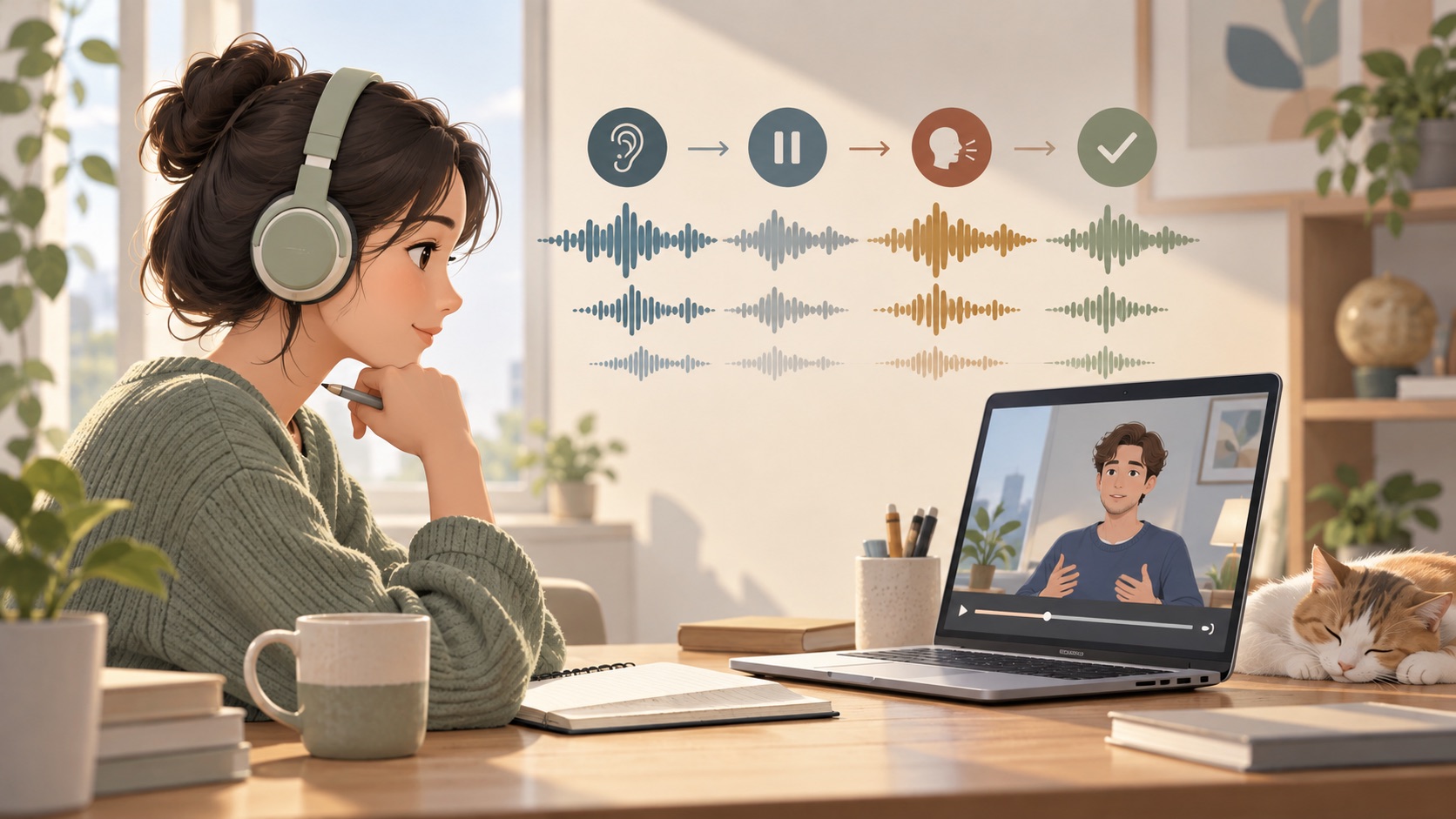
Reading aloud begins with text and trains spelling-to-sound production. Retelling begins with meaning and reconstructs content in your own language. Shadowing begins with continuous sound and follows it after a short delay, coordinating perception, processing, and articulation. All three are useful; they do different jobs.
If you stare at captions and finish words before the speaker, you are closer to synchronized reading. If you pause and copy a whole line, you are doing delayed imitation. Both can scaffold shadowing, but the eventual leader should be your ear, not the transcript.
| Practice | Input starts with | Primary goal | Common confusion |
|---|---|---|---|
| Reading aloud | Text | Accurate, fluent production | Assuming smooth reading equals listening |
| Retelling | Meaning | Organization and active expression | Memorizing instead of rebuilding |
| Shadowing | Continuous audio | Online perception–production coordination | Reading ahead and chasing speed |
Choose audio that can give you useful feedback
The best criterion is not an attractive accent; it is comprehensible, audible, and repeatable speech. You should already understand the sentence and important expressions. Otherwise working memory must solve meaning and speech movement at once.
Start with one speaker, clean audio, natural but stable pace, and reliable English captions. Interview answers, talks, and explainers are usually easier than overlapping casual conversation. Keep each initial unit between five and twelve seconds.
- At least roughly 80% comprehensible on first listening
- No persistent music or overlapping voices
- A reliable transcript for checking
- A speaking style relevant to situations you care about
Mark thought groups, not caption line breaks
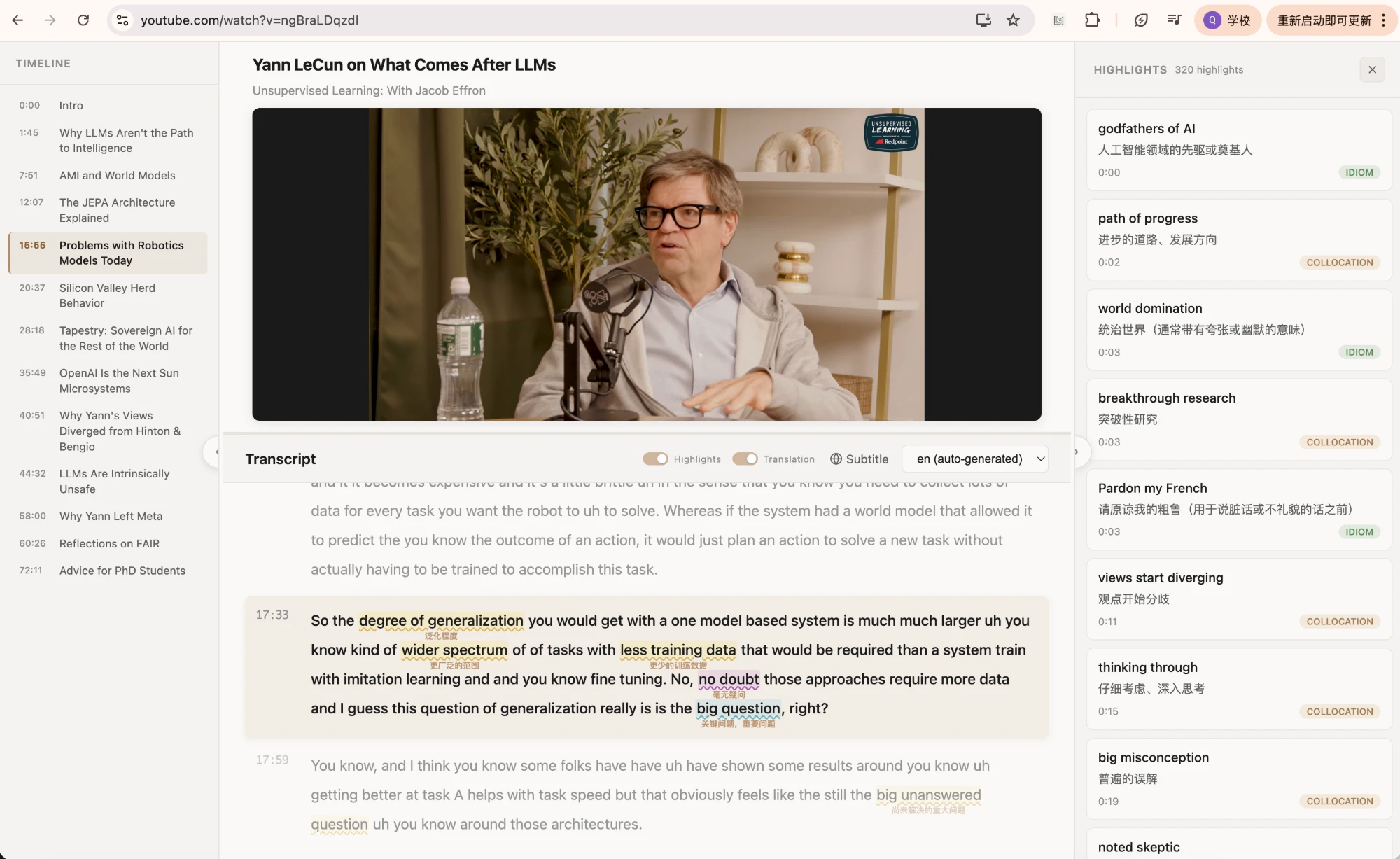
Caption wrapping serves screen space, not necessarily natural phrasing. A shadowing unit should be a thought group: a short, meaningful speech unit. Listen for stress, micro-pauses, pitch movement, and linking rather than cutting only at punctuation.
For example: “What we found / after talking to customers / was that speed wasn’t the real bottleneck.” The groups frame the finding, supply background, and deliver the conclusion. Practice them separately before reconnecting the sentence.
A four-stage shadowing progression
Do not start with blind full-speed following. Remove scaffolding gradually so you can locate whether a breakdown comes from perception, meaning, or articulation.
- Stage 1: understand and mark groupsListen twice, check the English transcript and contextual meaning, mark natural boundaries, and paraphrase the line.
- Stage 2: low-volume transcript synchronizationSpeak with the audio while watching the line. Attend to stress, reduction, and linking. Do not overpower the model.
- Stage 3: follow 0.5–1.5 seconds behindLet your ear receive a group before speaking. If words disappear, shorten the unit or slow briefly instead of reading ahead.
- Stage 4: transcript-free shadowing and retellingAfter two or three stable runs, hide the transcript. Finally pause and retell the idea in your own words.
What to imitate—and what you can leave alone
Prioritize thought-group boundaries, sentence stress, reduction, linking, and intonation. These cues help a listener recover information structure. Individual sounds matter, but they should not erase rhythm from the first round.
You do not need to imitate identity markers, exaggerated performance, or an accent you do not intend to use. The goal is clearer output organized in an English-like information pattern, not the removal of your identity.
| Feature | What to hear | Self-check |
|---|---|---|
| Thought groups | Where a speaker briefly resets | Can you breathe at the same boundaries? |
| Stress | Which content words stand out | Does your recording stress every word equally? |
| Reduction | How function words shorten | Are a / to / of unnaturally full? |
| Linking | How boundaries connect | Are you producing isolated word blocks? |
| Intonation | Stance and continuation | Does your pitch communicate the same relationship? |
When you fall behind, do more than set playback to 0.5×
Slower playback can reveal sound changes, but extreme slowing distorts natural rhythm. Diagnose the break. If the line is difficult even while reading, articulation or chunk familiarity may be the problem. If transcript-supported speech works but audio-only following fails, perception and segmentation need work. If sound is clear but meaning is not, solve comprehension first.
Treat each cause separately, then return to natural speed: isolate a difficult link, use a short dictation to test perception, or resolve the expression in context. Ten unfocused repeats do not supply that feedback.
An 18-minute session and a weekly rhythm
A few sentences revisited on another day make progress easier to observe than a long burst of same-session repetition.
| Time | Task | Evidence of completion |
|---|---|---|
| 0–4 min | Understand 2–4 lines and mark groups | You can paraphrase each |
| 4–8 min | Transcript-supported synchronization | Stress and reductions are identified |
| 8–14 min | Three delayed runs per line | No reading ahead or recurring omission |
| 14–18 min | Hide transcript and retell | Main rhythm and meaning survive |
| Next day | Five-minute natural-speed retest | First attempt improves over last first attempt |
Measure progress without asking “Do I sound native?”
Track three observable outcomes: how much survives on the first transcript-free attempt, whether thought-group boundaries remain stable, and whether your retelling can actively use one expression from the source.
Keep one 20–30 second recording each week and compare the first and final versions. If only the final same-day take improves, but the next day’s first take does not, the skill may still depend on short-term mimicry rather than stable retrieval.
Frequently asked questions
Do I need to understand everything before shadowing?
You should understand the sentence and key expressions. Otherwise meaning, segmentation, and articulation compete at once. A few nonessential unknown details are fine.
Should I look at captions while shadowing?
Use English captions initially to mark thought groups and solve sound–spelling problems, then remove them. The final stage follows audio rather than reading ahead.
How long should I shadow each day?
A focused 15–20 minutes is often easier to sustain and diagnose than an occasional hour. Small units, clear feedback, and a next-day retest matter more than a fixed duration.
Sources and verification
- The Effects of Shadowing on Listening Processing of L2 CollocationsResearch on shadowing and auditory processing of L2 collocations.
- Captioned video for L2 listening and vocabulary learning: a meta-analysisEvidence on captions, L2 listening, and vocabulary learning.
- Improving L2 vocabulary learning through retrieval and spacingResearch combining retrieval practice, spacing, and related memory techniques.