Editorial disclosure: This page is written by the LeMingle team. Competitor facts are sourced from official pages and dated; recommendations reflect product positioning, not invented test data.
Who this guide is for
- Relingo users considering an alternative without discarding their vocabulary library
- Professionals and students who read English articles, forums, and public work material
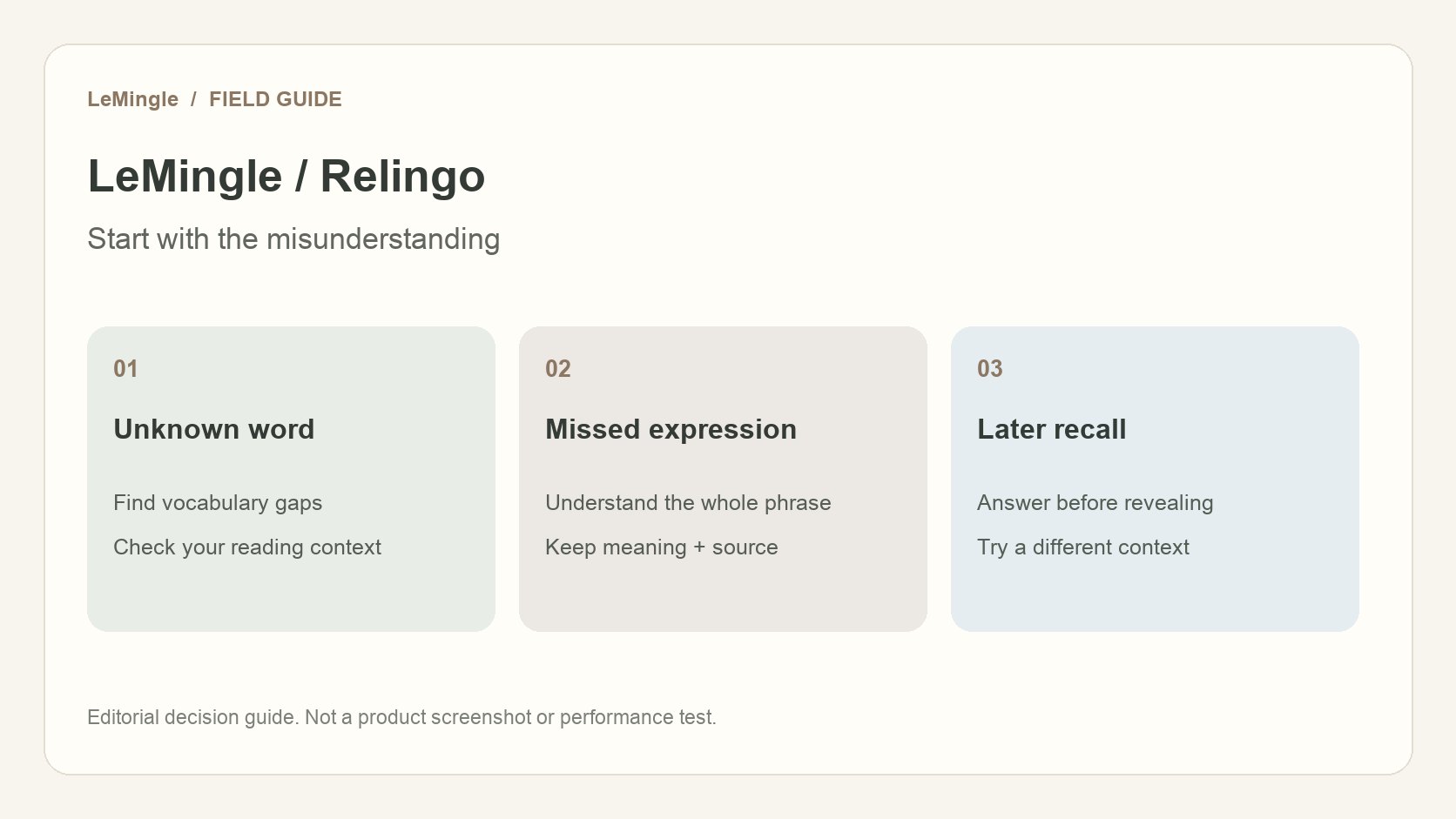
- YouTube viewers who understand individual words but miss the meaning of a phrase
- Learners who save plenty of material but want evidence that they can recall it
What this comparison establishes—and what it does not
The LeMingle team wrote this article. We reviewed Relingo’s website and upgrade page on October 2, 2026, and checked LeMingle’s review features against the current extension code. This is a documentation-based comparison, not a controlled trial of accuracy, reliability, or long-term retention.
Recommendations below are editorial judgments. The teaching sentences are written for this guide, not quotations from a customer or output from a product test. Use your own material to check whether phrase boundaries and explanations are actually useful. A listed feature establishes scope, not consistent performance on every page.
Start with the kind of misunderstanding you have
When several words in each paragraph are unfamiliar, identifying vocabulary gaps is a practical priority. Relingo foregrounds highlighting connected to difficulty and personal word knowledge. This is not only a beginner’s problem: an experienced professional entering a new field can encounter a dense layer of unfamiliar terminology.
A different obstacle is quieter. You know each word but do not notice that a group needs to be understood together. LeMingle identifies categories such as idioms, collocations, and vocabulary in the original text, with explanations connected to the current context. Its job includes getting from misunderstanding to understanding—not only helping people who already understand everything.
These are starting points, not exclusive territories. Relingo has explanation and phrase-related features; LeMingle also identifies vocabulary. Your question should be which tool consistently catches the kind of misunderstanding that matters in your material. Neither can guarantee it will find every useful expression or explain every implication correctly.
Compare the decisions that affect your routine
This table maps public capabilities and current code, not learning outcomes. Check the exact page, caption language, and device you intend to use.
| Job | Relingo | LeMingle |
|---|---|---|
| Find vocabulary gaps | Foregrounds difficulty-aware and personal-vocabulary highlighting | Identifies vocabulary plus expression categories |
| Interpret a familiar-word phrase | Lookup, examples, and explanations; test the particular phrase | Contextual expression explanation; check the extraction boundary |
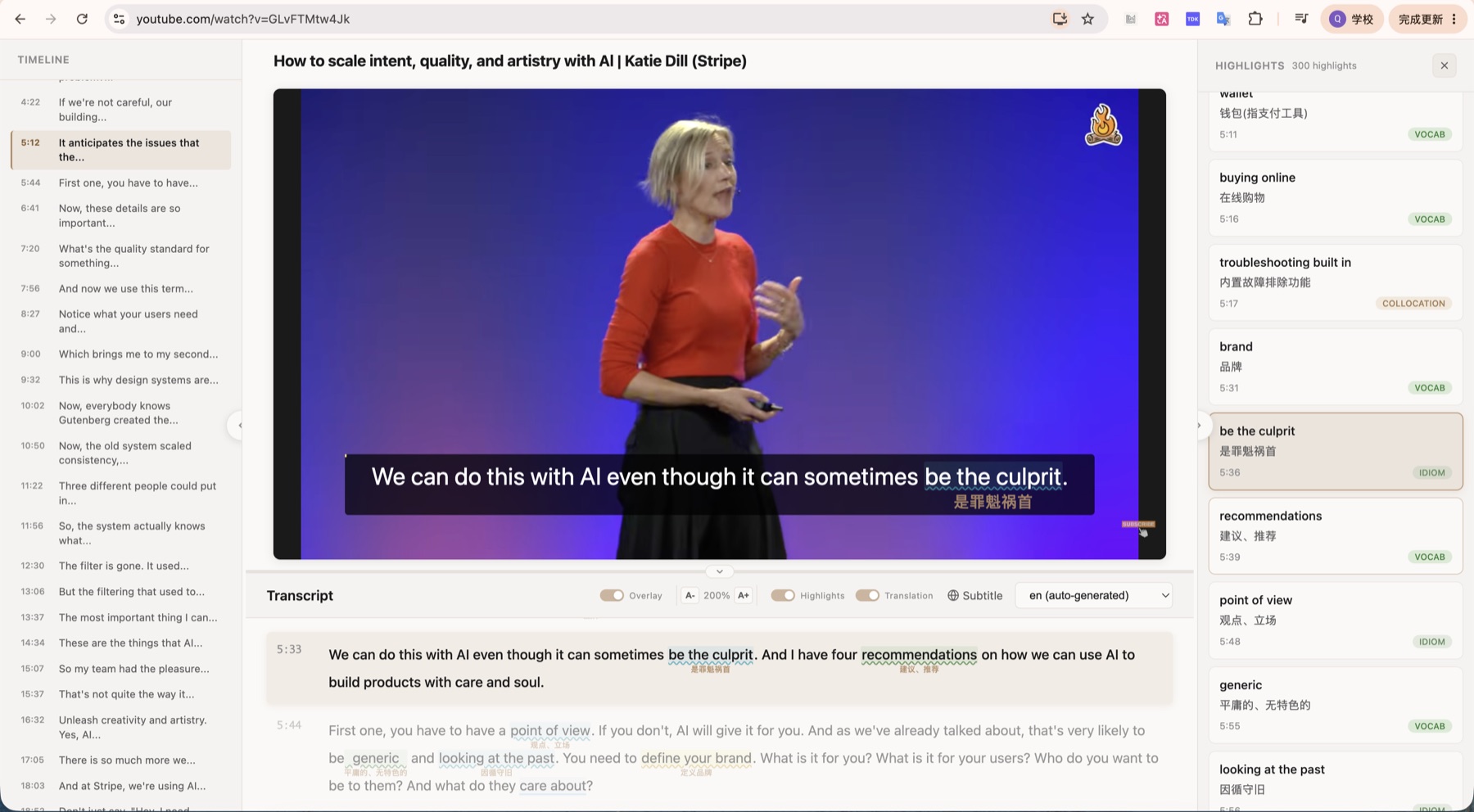
| Learn from YouTube | Publicly describes dual subtitles and vocabulary learning | Reader aligns captions, transcript, and expression list |
| Review saved material | Describes flashcards, word training, and later encounters | Saved-expression flashcards, familiarity marks, and video-grouped records |
| Change devices | Offers browser and mobile entry points; verify feature parity | Extension cloud sync verified; a released native review app not verified here |
| Move existing records | Upgrade page lists import/export and Anki export | CSV export exists; no verified Relingo import or review-history migration |
Test what survives after you close the article
Choose a public article you genuinely want to read. Find three points you misunderstand or might want to use later. Test each tool separately. More colored text is not automatically more useful material, and the record you keep matters more than the visual effect during reading.
For “gain traction,” a definition such as “make progress” might not be enough for writing. The source sentence tells you what is progressing; the surrounding paragraph shows whether the author means adoption, internal support, or market demand. Write a personal example such as “Our new onboarding flow is gaining traction with first-time users.” Then ask whether the meaning is plausible in that context.
Inspect the actual saved fields. Does the record keep the expression, the explanation you saw, an example, and a source? Can you return to why it interested you? Do not assume a screenshot in a marketing page proves every field is saved in your account. A useful record should support later understanding, not merely prove that you clicked Save.
- Understand firstWrite your interpretation before opening the explanation. Mark whether an unfamiliar word or a familiar-word phrase caused the mistake.
- Inspect the recordCheck which context and source fields actually remain after saving. Note anything you must add manually.
- Transfer itWrite a new sentence relevant to your work, course, or interests. Flag uncertainty about register and collocation instead of treating the phrase as a universal upgrade.
Repeated encounters and flashcards solve different review problems
Both products discuss encountering saved language again. A new sentence can reveal a different use or subject. However, what you happen to read determines when an expression appears; an encounter mechanism does not guarantee that tomorrow’s weakest item will come back. This is neither an exclusive LeMingle feature nor equivalent to a scheduled review queue.
LeMingle’s extension includes flipping saved-expression cards, viewing context, pronunciation, familiarity marking, and syncing review status. It also organizes YouTube expression records by video. These features support active recall. The review code inspected for this article does not establish a mature adaptive spaced-repetition scheduler, so we do not claim one. Relingo also describes flashcards and training; verify its current scheduling behavior if that is decisive.
Rawson and Dunlosky’s review of successive relearning discusses combining retrieval with practice spread across sessions. That supports a practice principle, not the effectiveness of either extension. The practical distinction is whether you attempt an answer before seeing it. Looking at a familiar highlighted translation again can feel easy without demonstrating recall.
Separate subscription cost, translation credits, and upkeep
Relingo’s upgrade page distinguishes a free version, Premium, and credits for paid translation engines. It also lists saving, examples, and export boundaries. The retrieved page did not reliably expose the Premium checkout price or every entitlement marker, so we will not recycle an old amount or assign an isolated number to a plan without evidence.
For LeMingle, check the current pricing page and checkout. In either product, identify which paid capability your routine actually requires: more understanding assistance, a larger saved library, or review you will use. A subscription and usage-based engine credits are not necessarily the same expense.
Upkeep is a separate cost. Fifty new items a night can become a library you avoid. During one ordinary session, note how long you spent managing records and whether you still finished the content you came to read. An annual discount is not a reason to pay for a workflow you have not tried.
If you already use Relingo, protect your existing library
Your edited explanations, examples, and familiarity marks are investments. Keep the original account and a backup. Export a small sample of records first and check whether the fields you value remain. An export file opening successfully does not mean another app can import it, deduplicate expressions, or preserve your review history.
We have not verified a one-click Relingo-to-LeMingle migration. If your goal is additional expression discovery, a safer experiment is to keep reviewing the old library where it is and capture only new material in LeMingle. Enable just one overlay at a time. Thousands of existing records should not become an entry fee for trying another tool.
For confidential work, review permissions, data handling, and your organization’s rules before using either service. “Works on webpages” does not mean appropriate for private correspondence or unpublished documents. This comparison is not a security assessment, and feature fit does not settle the privacy question.
Make a recorded choice rather than taking our word for it
Try comparable passages with each tool, then reverse the order. Reusing an already understood passage can favor the second product because you have learned the content. This is a personal selection exercise, not a scientific benchmark. Record concrete incidents rather than inventing an accuracy percentage from a few examples.
Keep Relingo if vocabulary discovery and library management already solve your problem. Try LeMingle when your repeated difficulty is identifying and understanding whole expressions in webpages and YouTube. If the missing step is doing review at all, improve that routine before purchasing another discovery tool. The right answer may be to stay with what you have.
| Record | Useful observation |
|---|---|
| Comprehension obstacle | Was it a word, phrase, syntax, or missing background knowledge? |
| Discovery quality | Which suggestions changed understanding, and which distracted you? |
| Later recall | Could you explain the expression without its definition and recognize a new use? |
| Time and entitlement | Did you finish the article, and was a paid feature necessary? |
Frequently asked questions
Does Relingo support YouTube and review?
Its current website describes YouTube dual subtitles, flashcards, and vocabulary training. Calling it a word-only tool with no video support is outdated. Verify present plan limits and behavior on the device you need.
Does LeMingle rely only on passive encounters?
No. The extension has saved-expression flashcards, context, pronunciation, familiarity marks, and review-status sync. A mature adaptive scheduler and a released native mobile review service were not verified in this comparison.
Which tool guarantees better retention?
Neither can receive that claim from this research. We did not run a controlled retention study. Check your understanding, active recall, and recognition in a new context instead of comparing saved-item counts.
Sources and verification
- Relingo websiteReviewed October 2, 2026: highlighting, captions, review, and language scope.
- Relingo upgrade pagePlan and credit boundaries; Premium checkout price not reliably retrieved.
- Successive relearning (Rawson & Dunlosky, 2022)Learning-method evidence, not an extension benchmark.
- LeMingle YouTube ReaderReal interface; review features separately checked in extension code.