Editorial disclosure: This page is written by the LeMingle team. Competitor facts are sourced from official pages and dated; recommendations reflect product positioning, not invented test data.
Who this guide is for
- People choosing between Language Reactor and Trancy, not looking for a disguised brand advertisement
- English learners using YouTube, Netflix, or public course material
- Viewers unsure whether sound, phrases, or syntax cause their comprehension difficulty
- Users checking whether free features suffice before paying
Evidence and disclosure
The LeMingle team wrote this comparison. We reviewed Language Reactor’s official store listing, its Pro page, and Trancy’s current plan page on October 2, 2026. We did not run controlled tests of subtitle latency, transcription accuracy, or retention. Recommendations concern task fit, not measured performance.
The store listed Language Reactor 5.1.8, updated July 1, 2026. A website feature and an extension release need not move together. Trancy’s dynamic paid amounts did not reliably load, so displayed zeroes are not evidence that paid plans are free. We retain unknowns instead of borrowing an old price or a competitor’s unsupported improvement percentage.
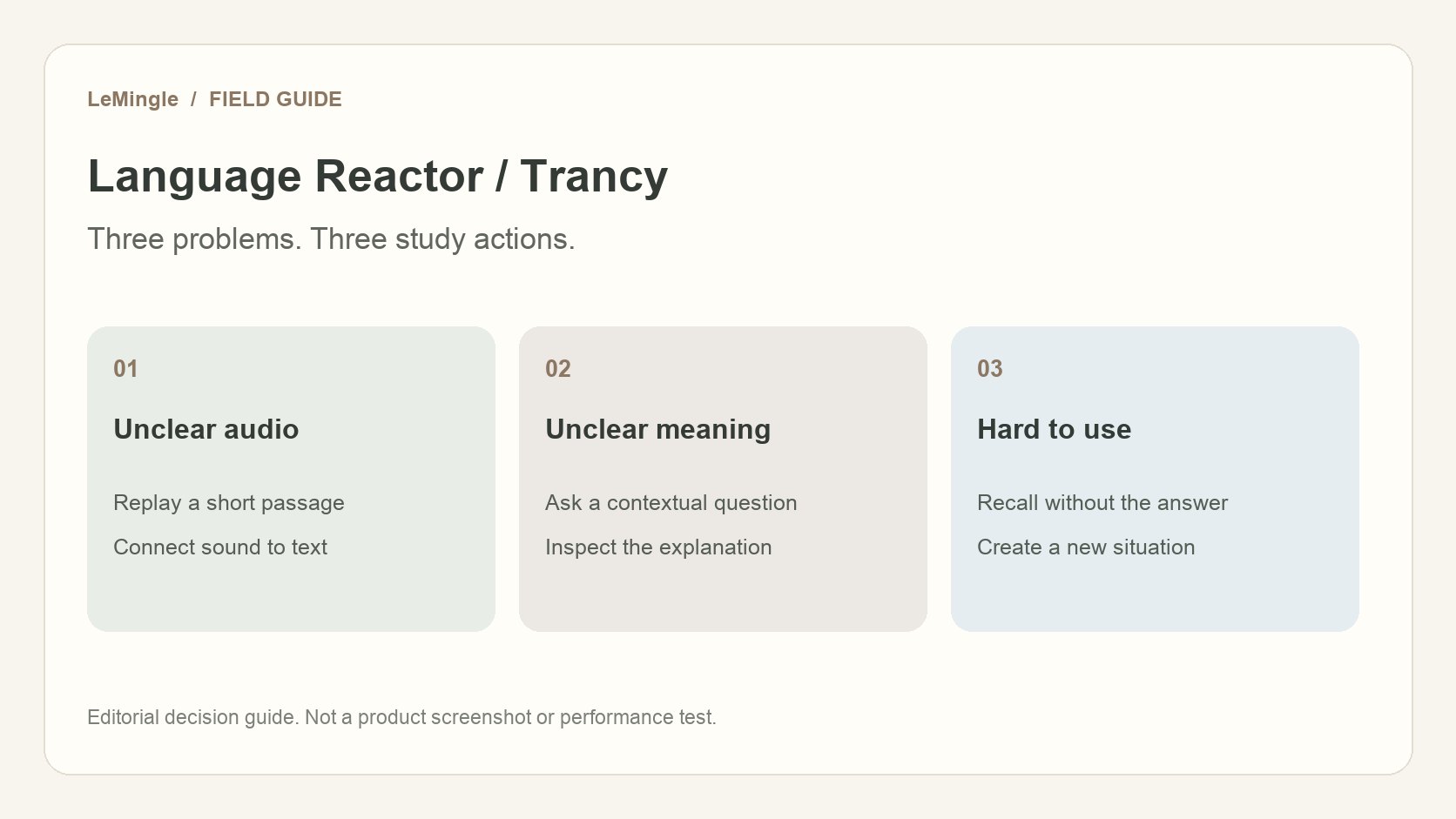
Diagnose the failure: sound, meaning, or use?
Sound: you understand the transcript but cannot segment the continuous audio without it. You need a short replay, useful subtitle boundaries, and control of the listening sequence—not necessarily another grammar explanation. Meaning: the words are visible but you cannot explain the message. You need vocabulary, phrase, syntax, or background help. Use: you understand the line but cannot retrieve suitable language in a new situation. That needs recall and transfer.
One person can have all three problems. Write down a recent interruption: could not return to the previous line, captions mismatched the audio, an explanation missed your question, or saved material never got reviewed. A concrete failure is more actionable than assigning yourself a permanent proficiency label.
An unfamiliar subject adds another obstacle. Understanding a technical debate may require domain knowledge, not just translation. Choosing material on a topic you know can be the better first adjustment. Similarly, following a native-language subtitle is not proof that listening has improved.
A capability map tied to those problems
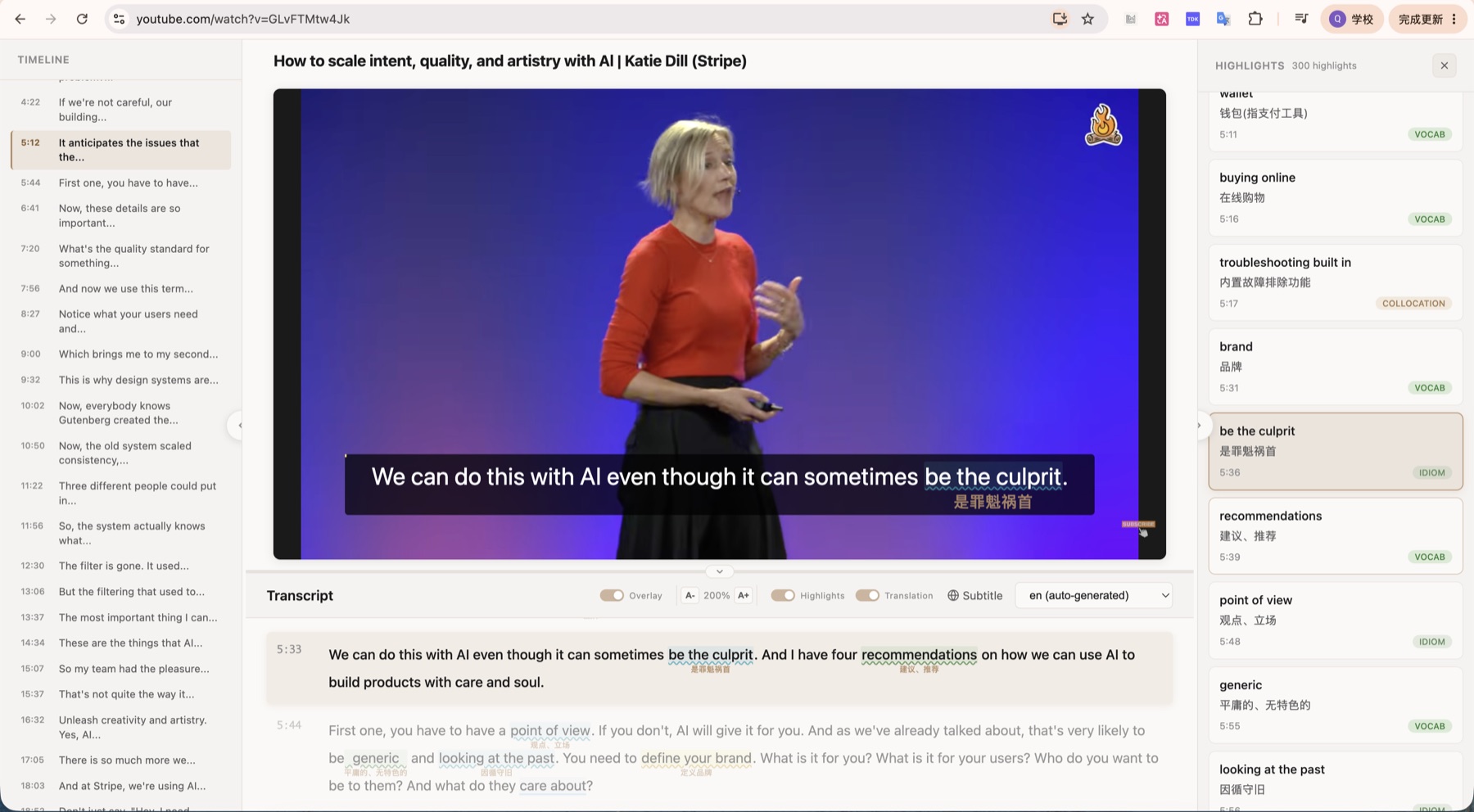
These are documented capabilities, not guarantees of identical behavior across platforms, languages, and plans. Separate a desktop extension, a web feature, and a mobile product.
| Task | Language Reactor | Trancy |
|---|---|---|
| Desktop sentence study | Store emphasizes Netflix/YouTube, dual subtitles, and playback control | Plan page lists subtitles across video and course platforms |
| Written material | Store describes text import, translation, and read-aloud | Describes immersive webpage translation |
| Contextual explanation | Pro page includes Lexa AI assistance | Plan page includes AI definition and sentence-analysis features |
| Study after saving | PhrasePump, word/phrase saving, and Pro export | Collection, flashcards, and Learning Center features |
| Missing suitable captions | Pro description specifies Netflix speech recognition | Paid plan describes YouTube transcription and quotas |
| Phone continuation | Do not infer native-video-app coverage from web support | Mobile entry point exists; verify your exact activity |
When sound is the problem, test a complete replay sequence
Choose a short excerpt you understand when reading. Listen without native-language subtitles and write what you hear, allowing gaps. Reveal the target-language text and mark misheard or missing parts. Then hide the text and listen again. The action is connecting sound to language, not refreshing an easier translation.
Language Reactor foregrounds playback control in its listing, making this a sensible workflow to test first. Trancy also describes video exercises and segmentation. Check whether you can return to the difficult line, retain useful surrounding context, and repeat without losing attention to controls. Do not decide that either interaction is better before trying the activity you need.
Smart segmentation is not the same as verified audio alignment. A complete semantic sentence can span several original caption timestamps. Combining them may help reading while changing the boundaries of a replay. Record the particular source and caption track when a mismatch occurs; one incident does not prove universal unreliability.
- Keep an unaided first answerWrite the sound you heard before revealing a translation. Leave blanks instead of reconstructing an answer afterward.
- Inspect the target-language textMark genuine errors and decide whether sound, vocabulary, or phrase meaning caused them.
- Return to audioHide the text and replay the short excerpt. Check whether the remaining difficulty still depends on reading.
When meaning is the problem, ask a specific question
For “out of the woods,” a generic request for the meaning may produce a generic definition. A useful question is why the speaker remains cautious after a successful first release. Are they expressing optimism, residual risk, or exaggeration? The phrase can also concern a literal forest; which interpretation fits this sentence?
This is not a task reserved for one AI-branded product. Language Reactor has AI assistance, and Trancy lists explanation and analysis capabilities. Compare whether the response answers your question, preserves the relevant context, and distinguishes plausible meanings. An AI label is not evidence of accuracy.
If you know every word but miss the expression, a word-by-word definition or a long syntax analysis may not address the obstacle. Identify the phrase boundary, then check surrounding content. When the original is ambiguous, an overly confident answer is not necessarily helpful. Preserve uncertainty and seek reliable human clarification for consequential information.
When use is the problem, inspect what happens after Save
Language Reactor’s Pro page distinguishes free word/phrase saving within PhrasePump from broader Pro saving and export. It is inaccurate to say free users cannot save anything. Trancy’s plan page lists collection limits and study-center features; inspect current account entitlements rather than assuming every practice mode belongs to every plan.
After saving “out of the woods,” return in another session with the definition hidden. Describe a situation that is improving but still risky, then write a personal sentence. If you recognize yesterday’s line but cannot judge a new use, the missing task is transfer—not necessarily a larger saved library.
A review of successive relearning provides a learning-method basis for retrieval across sessions, not a controlled comparison of these tools. Check whether the study entry point is accessible, whether records preserve useful context, and whether you answer before looking. “Has flashcards” does not reveal how you will actually practice.
Check plan, platform, and data boundaries before paying
A video with no captions, a missing target-language track, and a player change are different failures. First check whether the source has appropriate captions. Trancy describes paid YouTube transcription; Language Reactor’s Pro page describes Netflix speech recognition. Neither statement establishes transcription for every video on every service.
The reviewed Trancy page lists basic free subtitles and translation with collection limits, and paid transcription and learning capabilities. Language Reactor separates free from Pro. We did not reliably retrieve their dynamic checkout prices, so we do not name a cheaper winner. Compare billing period, tax, AI allowances, cancellation, and the particular feature you need.
List the sites and devices you actually used during an ordinary week. More supported platforms matter only when you use them. A mobile webpage or app does not prove subtitle overlays work in native Netflix, on television, or in every mobile browser. Confirm the specific surface instead of counting badges.
Before saving course material, workplace documents, or private correspondence, check data handling and organization rules. We do not turn permission counts into a security score or assert that any service never sends content to servers. This is a learning-workflow comparison, not a security audit.
| Before purchase | Why it matters |
|---|---|
| Does the source have the caption track I need? | Distinguishes missing material from an extension-reading problem |
| Which plan includes the necessary action? | Free subtitles do not imply unlimited AI or collection |
| Can I study on my actual device? | Desktop demonstrations do not establish mobile parity |
| Can I export the fields I care about? | Collection limits are not a media or history migration protocol |
When LeMingle is relevant—and when it is not
If you searched for Language Reactor versus Trancy, finish that decision first. You do not need a third product just because the publisher of this article sells one. For Netflix, course-platform coverage, or broad translation, LeMingle is not the equivalent replacement recommended here.
LeMingle becomes relevant when your unmet need is discovering and understanding idioms, collocations, and other expressions in webpages and YouTube. It also has saved-expression flashcards and video records; it is not passive highlighting alone. We do not claim a mature adaptive scheduler or that competitors cannot explain expressions.
Use one subtitle or highlighting overlay at a time. Multiple systems can overlap controls, shortcuts, and translations, making the video harder to watch and the source of a problem harder to identify. Evaluate a focused task before building a stack of tools.
Let an ordinary session decide
For desktop YouTube and Netflix sessions dominated by sentence replay, start with Language Reactor. For courses, webpages, and a wider mix of video sources requiring translation and practice, start with Trancy. These are starting recommendations based on documented scope, not universal conclusions about quality.
Use comparable fresh excerpts, complete one primary task—sound, meaning, or use—and reverse the tool order on another pair. Record interruptions, required actions, explanation corrections, later recall, and paid entitlements encountered. Familiarity from viewing a clip twice is not proof that the second tool teaches faster.
Stay with your current system if it resolves the recurring obstacle. An extra button is not a reason to migrate a useful library. Switching earns its effort when it removes a difficulty you repeatedly face in the time and material you actually have.
Frequently asked questions
Does Language Reactor lack AI?
No. The current official Pro page describes Lexa AI and chat-related assistance. Traditional subtitles versus an AI product is an outdated framing.
Which free plan is better value?
Check whether the action you need is included. Both offer basic capabilities, with different saving, transcription, and explanation boundaries. Dynamic checkout prices were not reliably retrieved, so this article does not rank them on price.
Are generated subtitles enough for learning?
Inspect both text and timing. Transcription can mishear names, terminology, hesitation, and negation. Understanding a translation is also not proof that you can follow audio without text or use the language yourself.
Sources and verification
- Language Reactor — Chrome Web StoreChecked October 2, 2026: version 5.1.8, updated July 1, 2026; platform scope.
- Language Reactor ProAI, saving, export, and speech-recognition boundaries; dynamic price not retrieved.
- Trancy current plansFree/paid scope; price placeholders are not checkout amounts.
- Successive relearning (2022)Method evidence, not a product-effect comparison.