Editorial disclosure: This page is written by the LeMingle team. Competitor facts are sourced from official pages and dated; recommendations reflect product positioning, not invented test data.
Who this guide is for
- Learners evaluating a Migaku alternative and the cost of changing systems
- Professionals learning English from interviews, industry articles, and YouTube
- People who discover language at a computer but need to review on a phone
- Existing Anki or media-card users who want to protect their study history
Research scope: Migaku is not simply an older, non-AI tool
The LeMingle team wrote this guide. We checked Migaku’s getting-started documentation, product pages, card-creation guidance, and pricing on October 2, 2026, alongside LeMingle’s current extension code. We did not purchase a competitor account or conduct a controlled retention trial. Claims about speed, accuracy, and outcomes should not be inferred from this comparison.
Migaku’s own update history refers to development since 2021. That establishes an earlier product history, not a precise incorporation date. Current documentation also includes AI-assisted explanation. Age is not a useful shortcut for deciding whether its present workflow fits your needs.
Two ways to connect content with something you can study later
Migaku’s card-creation guide describes taking a word encountered in video into a card with sentence and media context, with destinations in its study system or Anki. This is a capture-and-study workflow, not merely a translation overlay. It matters when copying audio, images, and context is the work that prevents you from making useful cards.
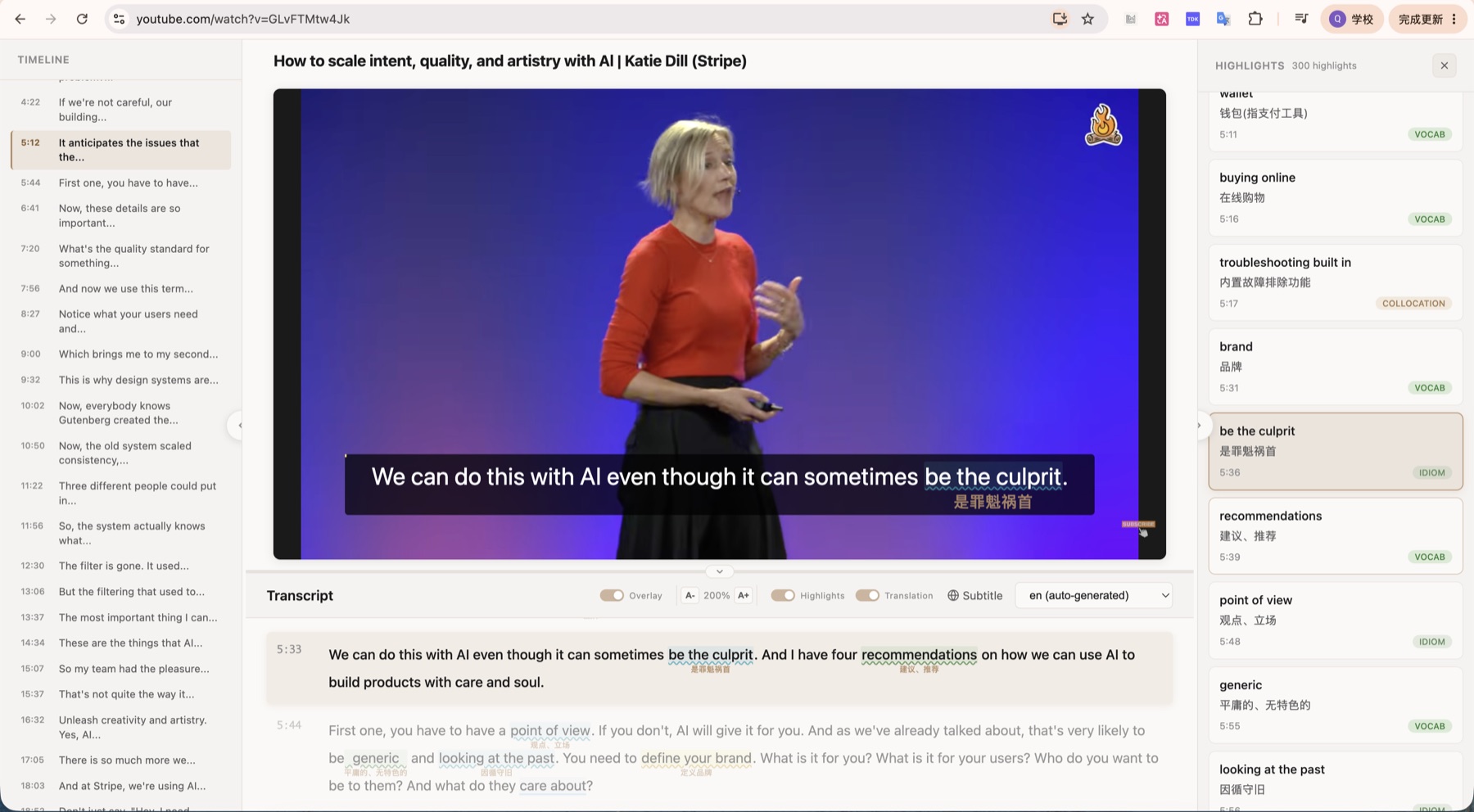
LeMingle starts by identifying expression categories in the original content. Hover explanations support understanding; saving connects to extension flashcards, familiarity marks, video-grouped expression records, and later highlighting. There is real overlap here. Describing LeMingle as passive-only or Migaku as word-only would make the recommendation easier but less accurate.
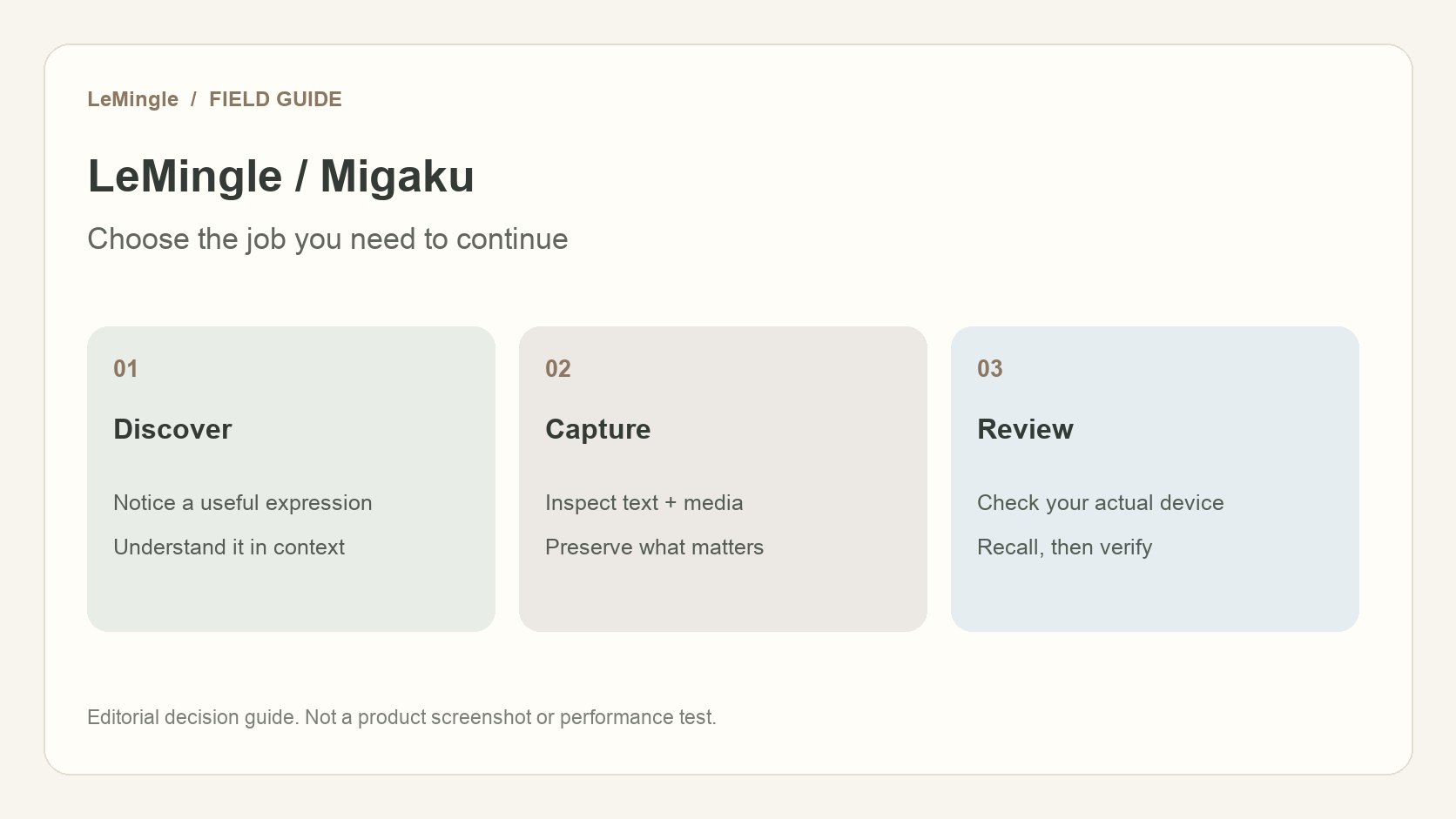
If you already know what to save and want richer media records with less manual assembly, Migaku maps more directly to that task. If you fail to notice that familiar words belong together, LeMingle’s expression discovery is a relevant starting point. This is a positioning judgment, not evidence that one model extracts phrases more accurately.
| Decision | Migaku | LeMingle |
|---|---|---|
| Discovery | Lookup and word-knowledge tools in a media-learning system | Identifies idioms, collocations, vocabulary, and other expression types |
| Understanding | Lookup plus officially described AI assistance | Contextual meaning and pronunciation; inspect phrase boundaries |
| Preserving media | Official card flow includes sentence, audio, and image context | Saved expressions and context; equivalent media packaging not verified |
| Active review | Own memory system with spaced review | Extension cards and familiarity state; mature adaptive scheduling not verified |
| Phone study | Official iOS and Android products | Released native mobile review service not verified here |
| Later content encounters | Word knowledge within a media-learning ecosystem | Saved-expression highlighting in subsequent content |
What makes an expression worth keeping?
Consider a teaching sentence written for this article: “Let’s push back on the timeline, not on the goal.” Separate definitions of “push” and “back” miss the communicative action. The speaker accepts the goal but wants the schedule challenged or reconsidered. This sentence is not a captured product result.
A useful record should help you explain what is being challenged, how direct the wording is, and when you might choose a softer alternative. “Push back on” can be ordinary discussion language, but it is not automatically polite in every relationship. In a customer email, “I’m concerned the timeline may not leave enough room for testing” might better express the same concern.
When tone and the preceding conversation matter, preserving source media is useful. When you want to recognize the expression across articles and your own reading, the phrase boundary and contextual explanation matter too. More fields do not prove better retention. They tell you which question you can answer when you return.
A phone should continue the review job, not imitate the whole browser
Migaku’s English product page explicitly connects desktop and mobile learning. For someone whose reliable study time is a commute, that is a substantive advantage. A mobile product does not imply every desktop-extension feature works inside every native streaming app, however. Verify the particular activity and device rather than interpreting “mobile” as universal support.
For your own cross-device trial, save one contextual item at a computer, open it on your phone, recall it, and change its state. Return to the computer and inspect the record. Check whether meaning, source context, and state remain consistent. If offline use is a requirement, test already-saved material without a connection and inspect what happens after reconnecting; do not assume availability from an app-store badge.
If you almost never study on a phone, mobile breadth may not justify changing your system. If a phone is your only dependable review location, LeMingle should not be presented as a complete replacement: this research did not verify a released native mobile review service. A future idea is not a current entitlement.
- Locate your real habitUse the last few actual review sessions, not the schedule you hope to keep next month.
- Complete a round tripSave, change device, recall, mark, and return. Record observed behavior rather than assuming synchronization.
- Check practical constraintsNetwork access, source audio, text size, headphones, and privacy may outweigh several extra modes.
Faster card creation does not remove the review burden
Automatically filling context and media can reduce assembly work. It cannot decide how much material you will realistically revisit. Twenty records from a short clip can become a backlog within a few sessions. Saved-item count measures capture, not understanding or later use.
Before saving, ask whether the item changes today’s comprehension, belongs in your likely future situations, and has enough context to review. Rare vocabulary can be interesting without being your next priority. If you already avoid your review pile, pausing new cards may be more useful than buying a faster capture workflow.
Research on successive relearning supports retrieval across separate sessions. It does not establish a universal daily card target, prove a particular scheduler’s superiority, or validate either product. Try answering before revealing a definition, then explain a different use. LeMingle’s familiarity labels help organize state, but marking an item “mastered” is not a measured long-term outcome.
Migaku’s public prices are visible; value still depends on your task
At this review date, Migaku’s pricing page and English product page list Standard at US$10 monthly or US$96 annually, Early Access at US$15 monthly or US$144 annually, and Lifetime at US$499 once. The public offer describes a ten-day trial. These are October 2, 2026 advertised amounts, not a guarantee of your taxes, promotion, billing terms, or refund eligibility.
Check LeMingle’s current pricing page and checkout for its limits. Do not reduce the decision to the smallest monthly number. If media cards, mobile study, or courses are not jobs you will use, a larger bundle may have little extra value. If they are requirements, a narrower alternative does not become sufficient merely by costing less.
Complete discovery, capture, and a later recall session during a trial. Installing an extension is not testing a learning system. A lifetime purchase adds uncertainty about both your future habit and the product’s future maintenance. Do not spread its cost over imagined years of daily use before establishing that the routine fits.
Protect media and history before attempting a migration
If you already have a Migaku or Anki collection, identify the broken stage first. Stable review with occasional missed expressions might call for an additional discovery layer, not a new memory system. Keep the old library where it works while trying a small amount of new content elsewhere.
Migaku’s documented destinations in its own system and Anki do not establish lossless transfer to arbitrary third-party products. LeMingle’s CSV export is also not a media-deck migration protocol. We have not verified automatic import of Migaku cards into LeMingle or preservation of scheduling history.
Check a few sample records for complete phrases, edited meanings, examples, source links, audio, screenshots, familiarity state, and review history. Backup first and retain access to the original. For workplace material, media capture also requires attention to organization and platform rules. A capture button does not itself authorize sharing the material.
| What might be lost | What to inspect |
|---|---|
| Expression boundaries and edits | Whether phrases become separate words or definitions are overwritten |
| Media and source context | Whether actual files or working links survive—not just text labels |
| Review state and history | Whether a familiarity tag is being mistaken for transferable scheduling |
| Access to the old library | Keep a backup and the original system until a small sample is verified |
Run a personal trial that resists novelty and familiar-content bias
Prepare comparable public video excerpts on topics you care about. Use one tool on the first and the other on the second, then reverse the order with fresh excerpts. A second pass through the same clip already benefits from what you learned. That can make the second tool look better without demonstrating better assistance.
Keep only a few relevant expressions per session. Record missed meanings, explanations needing correction, capture effort, later recall, and cross-device behavior. Fix the review time you are willing to spend. The trial should resemble your ordinary routine, not a sudden two-hour study commitment created to justify a subscription.
Choose Migaku’s broader documented workflow when media cards and mobile review are essential. Try LeMingle when expression discovery and understanding in your browser are the main missing pieces. When most vocabulary and basic syntax are unfamiliar, reduce material difficulty and add necessary foundational support rather than expecting an overlay to solve everything.
Frequently asked questions
Is Migaku an old tool without AI?
No. Current official documentation includes AI assistance. Its update history reaches at least 2021, but that does not establish a precise company founding date.
Can LeMingle’s flashcards fully replace Migaku?
Not on that fact alone. LeMingle has extension flashcards and familiarity state. Equivalent media packaging, native mobile study, and adaptive review scheduling were not verified in this comparison.
Should I switch if I already use Anki?
Identify the missing stage first. Keep an effective review system if expression discovery is the issue. Test Migaku’s media-card workflow if capture effort is the issue. Do not discard a library before validating transfer.
Sources and verification
- Migaku getting startedReviewed October 2, 2026: product scope and AI assistance.
- Migaku video card creationMedia capture and study destinations, not a universal migration guarantee.
- Migaku pricingAdvertised amounts; checkout and promotions require a separate check.
- Migaku English product pageCross-check for mobile learning and public prices.
- Migaku update historyProduct development reaching 2021, not incorporation evidence.
- Successive relearning (2022)General retrieval and spacing evidence, not product outcomes.